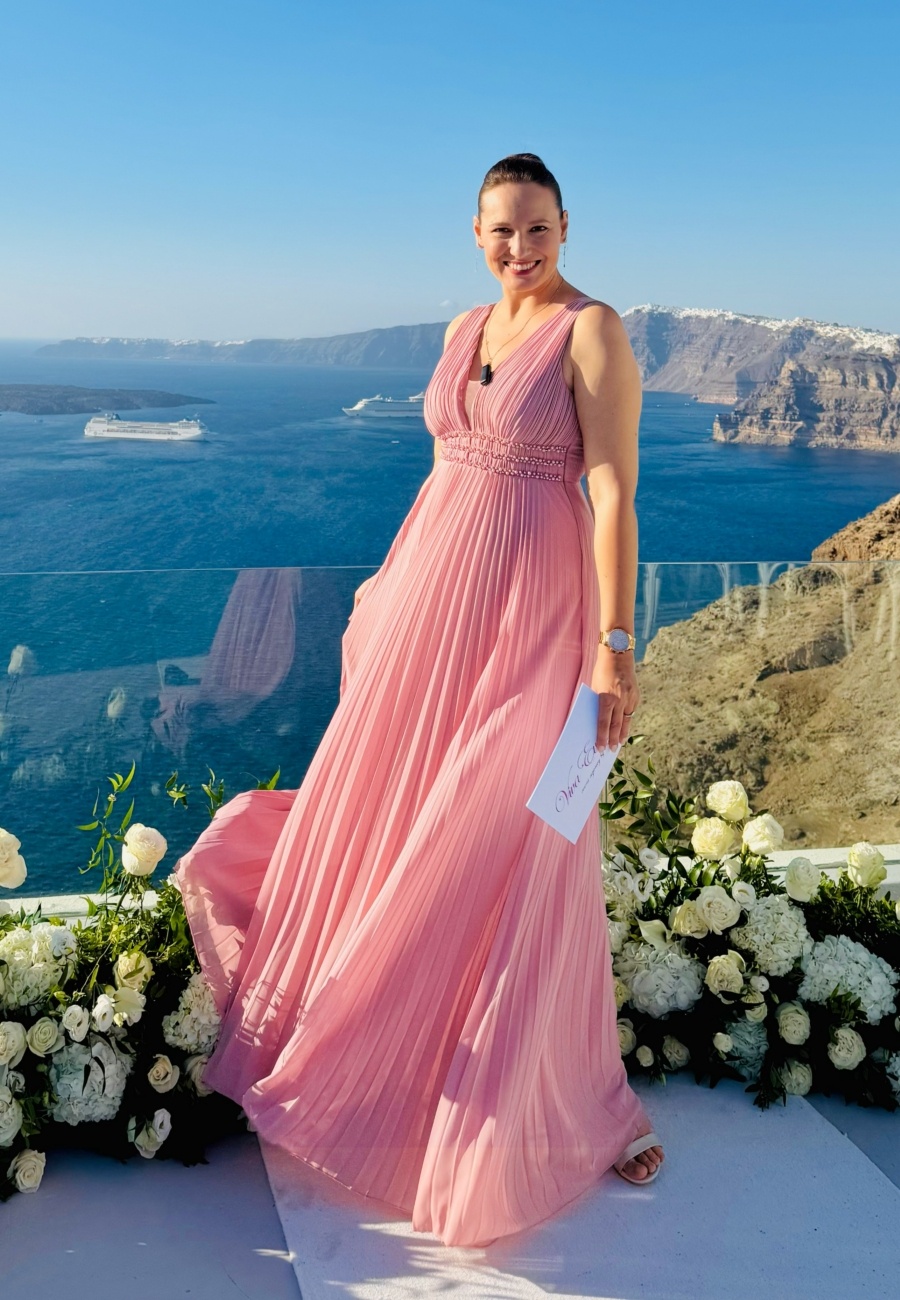
There is something wonderfully freeing about a wedding ceremony that does not have to follow a script written for everyone else.
For many international couples getting married in Greece, a symbolic wedding ceremony offers exactly that freedom.
It gives you the opportunity to create a ceremony around your story, your relationship, your families and the way you want to celebrate your commitment — without asking the ceremony itself to carry the legal responsibility of registering your marriage.
And when your guests speak different languages or come from different cultural backgrounds, this flexibility becomes even more valuable.
As a multilingual wedding celebrant working with international couples in Greece, I see the ceremony as much more than a formal moment between two people. It is the part of the wedding where everyone present should understand not only what is happening, but why it matters.
What Is a Symbolic Wedding Ceremony?
A symbolic wedding ceremony is a personalised wedding ceremony that celebrates your commitment without itself being the legal registration of your marriage.
For couples who complete the legal part of their marriage separately, a symbolic ceremony can become the moment they truly experience their wedding together with their families and friends.
This means that the ceremony can be created around you.
There is no need to force your story into a standard sequence simply because that is how ceremonies have traditionally been done.
Instead, we can decide together:
- how you would like to tell your story;
- what you want your vows to sound like;
- whether you would like to include family members;
- which traditions genuinely mean something to you;
- what languages your guests need;
- and what atmosphere you want the ceremony to create.
Why Do International Couples Choose a Symbolic Ceremony in Greece?
Greece attracts couples from all over the world, and not every couple has the same legal, cultural or family circumstances.
Some couples are already legally married in their home country and want to celebrate their marriage in Greece.
Others want a destination wedding ceremony that feels personal and meaningful without making the ceremony itself a legal procedure.
And for multicultural couples, there is another advantage: you can create the ceremony around your two worlds rather than choosing one over the other.
A Greek and British couple, for example, may want elements of both cultures. A Greek and Russian couple may want their families to hear important parts of the ceremony in both languages. An international couple may simply want everyone — whatever language they speak at home — to feel included.
A symbolic ceremony gives us the creative freedom to do that.
Is a Symbolic Wedding Ceremony Legally Binding in Greece?
A symbolic ceremony and a legal marriage are two different things.
The legal requirements for getting married depend on the couple's circumstances and nationality, so this is something that should be handled separately with the appropriate Greek authorities or qualified legal professionals.
Your celebrant's role is different. My role is to create and conduct the ceremony itself: the words, the story, the vows, the rituals, the participation of your loved ones and the flow of the moment.
For this reason, couples should establish their legal marriage arrangements separately and then design the symbolic ceremony around the celebration they want to share with their guests.
What Does a Wedding Celebrant Actually Do?
This is one of the questions I hear most often.
A wedding celebrant is not simply the person who stands in front of your guests and reads a prepared text.
A good ceremony should feel as though it could only belong to your couple.
My work begins long before the ceremony itself.
I learn about your relationship, how you met, what brought you together, the people who matter to you and the atmosphere you want to create.
From there, we build the ceremony. That may include your personal vows, readings, family participation, symbolic rituals, cultural traditions, music cues and transitions between different parts of the celebration.
On the day itself, I guide the ceremony so that it feels natural, elegant and emotionally connected — while keeping the timing and structure under control.
If you are looking for a wedding celebrant in Greece, the ceremony can be created around your story rather than around a standard script.
How Can You Personalise a Symbolic Wedding Ceremony?
Your story
Your ceremony should sound like you.
Instead of generic statements about love and marriage, we can include the moments, details and qualities that actually define your relationship.
Perhaps there is a story your guests know well. Perhaps there is something only the two of you understand. Those details are what turn a ceremony into your ceremony.
Your vows
You can write your own vows, work from a structure, or create something together with guidance. The goal is not to produce perfect literary text. The goal is to say something that you will still recognise as yours years from now.
Family and loved ones
Family members do not have to remain passive guests.
Parents, children, siblings, grandparents or close friends can become part of the ceremony through readings, blessings, symbolic rituals or other meaningful roles.
This can be especially beautiful for international couples, because it gives different generations and cultures a shared moment within the ceremony.
Cultural traditions
A multicultural wedding does not need to choose one culture and leave the other outside the door.
Greek traditions can sit naturally alongside traditions from another country when they are selected with intention.
The ceremony should not feel like a collection of customs. It should feel like one story made from two lives.
What About a Multilingual Wedding Ceremony?
This is one of the areas where careful planning makes an enormous difference.
I conduct ceremonies in English, Greek and Russian, and I often work with couples whose guests speak different languages.
A multilingual ceremony does not mean translating every sentence three times. That would quickly become repetitive and could turn a beautiful ceremony into a very long one.
Instead, the languages can be woven naturally into the structure.
- the welcome can acknowledge all guests;
- important parts can be delivered in more than one language;
- vows can be bilingual;
- family members can participate in their preferred language;
- certain readings or blessings can be chosen specifically for particular guests.
The aim is simple: everyone should feel included without feeling that they are listening to the same ceremony three times.
Where Can You Have a Symbolic Wedding Ceremony in Greece?
One of the beautiful things about Greece is the variety of settings available for a ceremony.
A symbolic ceremony can be created in a destination such as Santorini, by the sea in Halkidiki, in Athens, in Thessaloniki, or in another location that has meaning for you.
The setting changes the atmosphere, but it should never replace the ceremony itself.
A breathtaking view is wonderful. But what people remember years later is often something much smaller: the words someone said, the way a parent looked at their child, the promise you made to each other, or the moment everyone laughed together.
That is why I always see the location and the ceremony as two parts of the same experience — not as substitutes for one another.
How Long Should a Symbolic Wedding Ceremony Be?
There is no universal perfect length.
A ceremony should have enough time to tell your story and create emotional space, but not so much that the meaning gets lost.
The right length depends on:
- how much of your story you want to tell;
- whether you are including readings or rituals;
- whether the ceremony is bilingual or multilingual;
- how many people are participating;
- and the overall rhythm of your wedding day.
A multilingual ceremony, in particular, needs thoughtful editing. The objective is not to say more. It is to make every part count.
How Does the Planning Process Work?
I normally begin with a conversation with the couple.
We talk about your relationship, your plans for the wedding, your families, your languages and the feeling you want the ceremony to have.
Then we build the structure.
From there, we develop the wording, vows, rituals and family participation. The ceremony is refined until it feels natural to you.
And on the wedding day, my role is to hold that structure for you — so that you can stop thinking about what comes next and simply experience the moment.
A Symbolic Ceremony Should Feel Like Yours
There is no single correct way to have a wedding ceremony.
There is only the way that feels right for the two people standing at the centre of it.
For international couples, that often means bringing together different languages, families, cultures and traditions.
For some couples, the ceremony is intimate and quiet. For others, it is joyful, theatrical and full of laughter.
Some want traditional elements. Others want something completely personal.
My job is not to make every couple fit the same ceremony. It is to create a ceremony that fits them.
Ready to Create Your Ceremony in Greece?
If you are planning a wedding in Greece and want a ceremony that reflects your story — in English, Greek or Russian — I would love to hear about it.
Let’s talk about your ceremony