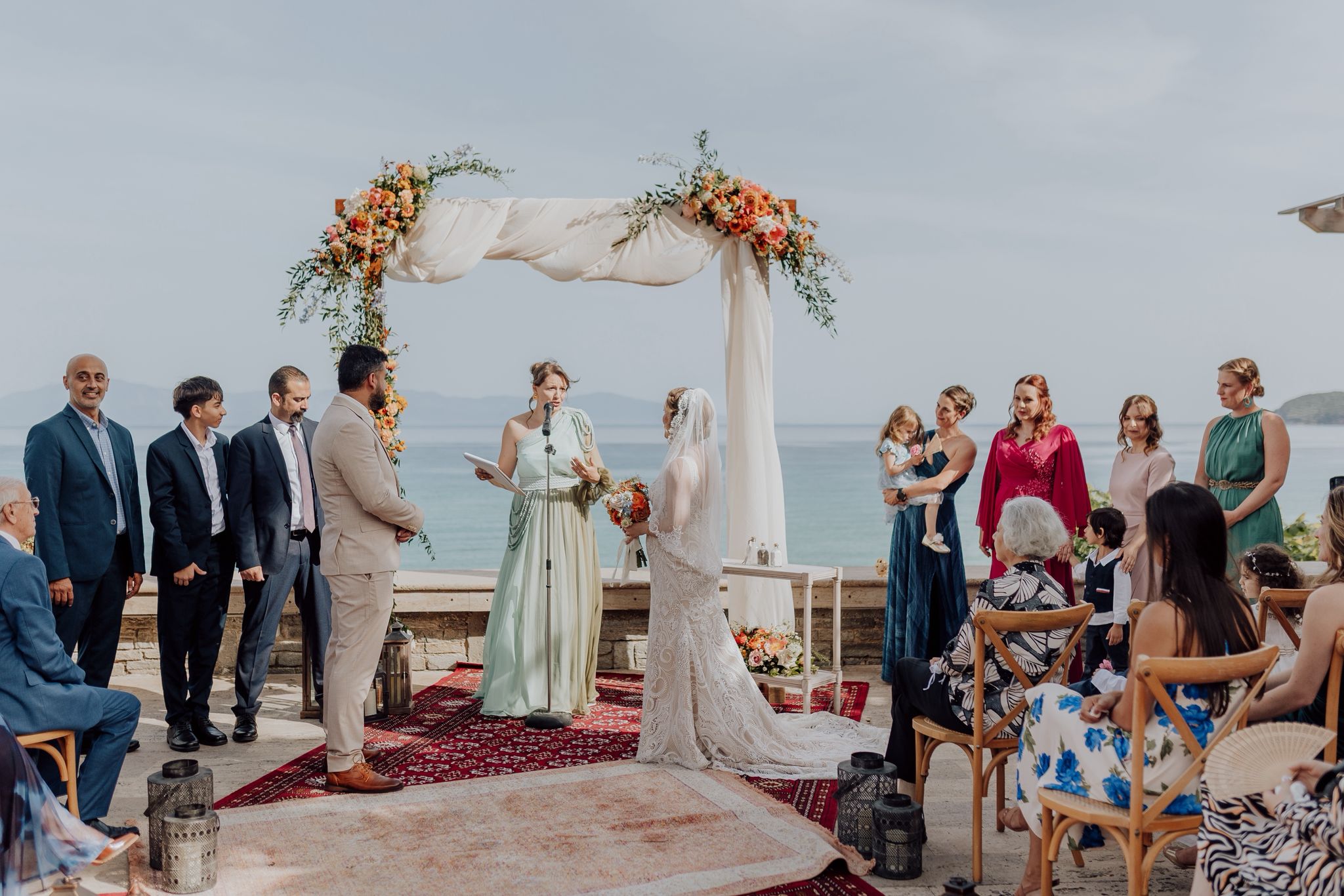
If you are planning a wedding in Greece, you may have come across the term wedding celebrant and wondered what exactly this person does.
Unlike some wedding roles, the work of a celebrant is centred on one very particular part of your wedding day: the ceremony itself.
A celebrant helps turn your relationship, your values, your families and your traditions into a ceremony that feels personal — rather than something taken from a standard template.
For international couples, this role can become even more valuable when different languages, cultures and family traditions need to come together naturally.
What Is a Wedding Celebrant?
A wedding celebrant is the person who creates and conducts a personalised wedding ceremony.
The celebrant works with the couple before the wedding to understand their story, decide what the ceremony should include and develop the wording, structure and rituals.
On the wedding day, the celebrant guides the ceremony from beginning to end — welcoming the guests, introducing the different moments, leading vows and rituals, and making sure the ceremony flows naturally.
The most important word here is personalised.
Your ceremony should not sound like a generic text with your names inserted into it. It should sound like the two of you.
What Does a Wedding Celebrant Actually Do?
The work begins long before the celebrant takes the microphone.
A typical process can include:
- getting to know the couple and their relationship;
- discussing the atmosphere and tone they want;
- creating the structure of the ceremony;
- writing or developing personalised ceremony wording;
- helping with personal vows;
- choosing meaningful readings, rituals or traditions;
- planning the participation of family members and friends;
- considering different languages and cultural backgrounds;
- coordinating the ceremony flow with the wedding planner, venue and other suppliers;
- conducting the ceremony on the wedding day.
In other words, a celebrant is both a storyteller and a ceremony guide.
Wedding Celebrant vs Wedding Planner: What Is the Difference?
This distinction is particularly useful when planning a destination wedding in Greece.
A wedding planner is generally responsible for the wider wedding experience: venue coordination, suppliers, schedules, logistics, décor, guest arrangements and many of the practical details surrounding the day.
A wedding celebrant focuses specifically on the ceremony: the story, words, emotional structure, rituals, vows and the way the ceremony is delivered.
The two roles can work beautifully together.
In fact, when the planner and celebrant communicate well, the ceremony becomes much easier to integrate into the overall wedding day.
The planner creates the environment around your wedding. The celebrant creates the words and moments that give the ceremony its meaning.
Wedding Celebrant vs MC: Are They the Same?
Not quite.
An MC (Master of Ceremonies) usually guides guests through the reception or wider event: introductions, announcements, speeches, dinner, entertainment and transitions between different parts of the celebration.
A wedding celebrant is focused on the wedding ceremony itself.
The roles can overlap, especially when someone has experience in both areas, but the skills and responsibilities are different.
For couples who want a ceremony that feels intimate and meaningful, choosing someone who understands ceremony writing and storytelling can make a significant difference.
Why Do International Couples Choose a Wedding Celebrant in Greece?
Greece is one of the world's most beautiful destinations for a wedding, but international weddings often bring an additional layer of complexity: the couple and their guests may not share the same language, culture or family traditions.
This is where a celebrant can help create a common experience.
Instead of asking one side of the family to simply follow the traditions of the other, the ceremony can acknowledge both.
Instead of translating every sentence word for word, the languages can be woven into the ceremony in a way that feels natural.
And instead of choosing a standard ceremony because it is easier, the couple can create something that reflects their particular story.
This is especially meaningful for multicultural couples, where the wedding may bring together relatives and friends who have travelled from several countries.
Can a Wedding Celebrant Conduct a Multilingual Ceremony?
Absolutely — but a multilingual ceremony needs more than translation.
I conduct wedding ceremonies in English, Greek and Russian, and I often work with international couples whose guests speak different languages.
The goal is not to repeat every sentence three times. That can make a ceremony unnecessarily long and can take away from its emotional rhythm.
Instead, languages can be integrated thoughtfully:
- the welcome can acknowledge guests in different languages;
- important parts of the ceremony can be presented bilingually;
- vows can be spoken in one or more languages;
- family members can participate in their preferred language;
- readings, blessings and rituals can be selected with the guests in mind.
The result should feel inclusive rather than translated.
What Happens Before the Wedding Ceremony?
One of the most valuable parts of working with a celebrant happens before the wedding day.
1. We get to know your story
The first conversation is about much more than dates and logistics. It is about how you met, what brought you together, the people who matter to you and what you want your guests to feel.
2. We create the ceremony concept
Together, we decide what kind of ceremony feels right for you. It may be intimate and elegant, emotional and traditional, relaxed and humorous, or a combination of several qualities.
3. We build the structure
We decide how the ceremony will flow: entrances, welcome, story, readings, family participation, vows, rings, symbolic rituals and the closing moment.
4. We develop the words
This is where the ceremony becomes personal. Your story, your language and your voice should shape the text.
5. We refine the details
We make sure that everyone involved knows what will happen, when they will participate and how the ceremony connects with the rest of the wedding day.
6. I conduct the ceremony
On the day itself, my job is to hold the structure for you. You should not have to think about what comes next. You should be able to experience the moment.
What Can You Include in a Celebrant-Led Wedding Ceremony?
There are no mandatory elements beyond what your chosen ceremony format requires. A personalised ceremony can include exactly the elements that feel meaningful to you.
For example:
- personal vows;
- love story or relationship story;
- readings and poems;
- family blessings;
- children's participation;
- ring exchange;
- symbolic rituals;
- cultural traditions;
- moments of remembrance;
- music and carefully timed transitions.
The important thing is not how many elements you include. It is whether they belong to your story.
How Long Does a Wedding Ceremony with a Celebrant Last?
There is no universal ideal length.
A ceremony should have enough space for the story, vows and meaningful moments without becoming unnecessarily long.
The length depends on the number of participants, readings and rituals, the amount of personal storytelling and whether the ceremony is bilingual or multilingual.
Multilingual ceremonies require particularly careful editing. The goal is not to add more words simply because more languages are involved. The goal is to make every part understandable, natural and emotionally effective.
How to Choose the Right Wedding Celebrant in Greece
Choosing a celebrant is a very personal decision. You are trusting this person with the words and rhythm of one of the most meaningful moments of your wedding day.
When speaking with potential celebrants, consider asking:
- Do they create personalised ceremonies?
- Have they worked with international or multicultural couples?
- Can they conduct the ceremony in the languages you need?
- How do they learn about a couple's story?
- Can they help with vows, rituals and family participation?
- How do they coordinate with the wedding planner and venue?
- Do you feel comfortable speaking openly with them?
The last question is often the most important.
Your celebrant will hear your stories, your hopes and sometimes the very personal details that make your relationship unique. You should feel that you can trust them to understand your story — and to tell it with warmth, elegance and respect.
What Makes a Great Wedding Celebrant?
A great celebrant is not simply a confident speaker.
They need to listen. They need to write. They need to understand people. They need to know when a moment needs space and when it needs energy.
For an international wedding, they also need cultural awareness and the ability to make different groups of guests feel included.
And on the wedding day, they need to be calm enough to hold the ceremony even when the unexpected happens.
The best ceremonies do not feel performed. They feel lived.
Is a Wedding Celebrant Right for You?
If you are looking for a ceremony that goes beyond a standard script, a wedding celebrant may be exactly what you need.
This can be especially valuable if you are planning a destination wedding in Greece, bringing together different cultures or languages, or simply want the ceremony to tell the real story of your relationship.
If you are also considering a symbolic wedding ceremony in Greece, a celebrant can help turn that freedom into a meaningful, beautifully structured experience.
Your Ceremony Should Sound Like You
If you are planning a wedding in Greece and looking for a wedding celebrant who can bring your story, languages and traditions together, I would love to hear about it.
Let’s talk about your ceremony