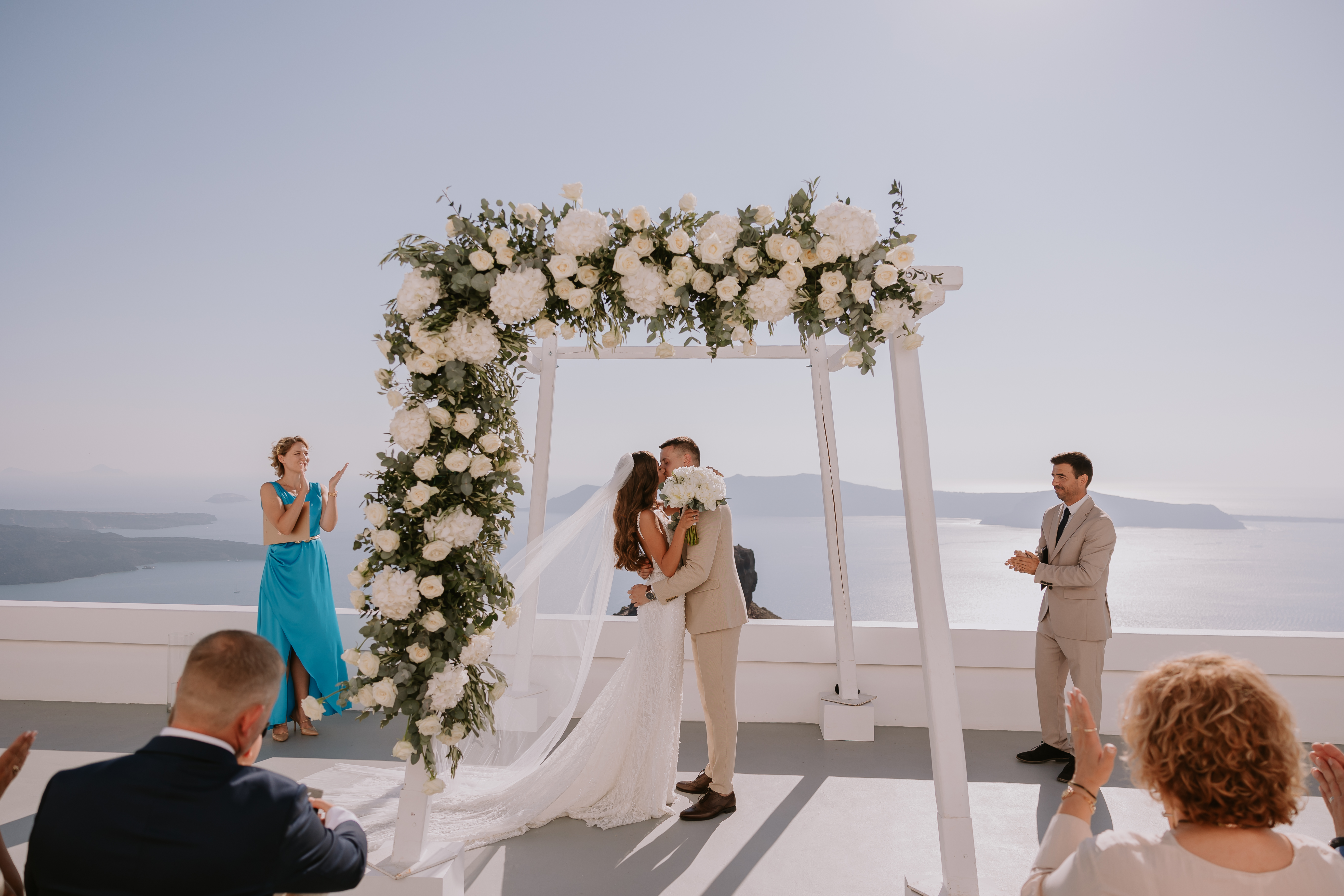
Choosing a wedding celebrant in Greece is about much more than finding someone who can stand at the ceremony and speak into a microphone.
For an international wedding, the celebrant becomes the person who holds the emotional thread of the ceremony: the story, the vows, the rituals, the languages and the little details that make the moment feel like yours.
There are many talented celebrants in Greece, so how do you know who is right for you?
Here are seven questions I recommend asking before you book.
1. Will the ceremony actually be personalised?
This is probably the most important question.
Ask how the celebrant gets to know you, what information they collect and how your story becomes part of the ceremony.
A personalised ceremony should go beyond simply inserting your names into a pre-written script. Your relationship, personalities, family dynamics, shared memories and the way you want to feel on the day should influence the words and structure.
Ask your potential celebrant:
- How do you learn about our story?
- Do you write each ceremony from scratch?
- Can we review and edit the ceremony before the wedding?
- Can we include our own vows, readings or family traditions?
The best ceremony is not the one with the most words. It is the one where the right words sound unmistakably like you.
2. What languages can the celebrant conduct the ceremony in?
For multicultural couples, language is not a small detail. It can completely change the experience of the ceremony for your guests.
If one partner speaks Greek, the other speaks English and part of the family speaks Russian, for example, you may want all three languages to have a natural place in the ceremony.
Ask whether the celebrant can conduct the ceremony themselves in the languages you need, rather than simply providing a translated script.
A multilingual ceremony should not feel like the same sentence being repeated three times. The aim is to create a rhythm in which every guest feels included without losing the elegance and emotional flow of the ceremony.
This is especially important for destination weddings in Greece, where couples and guests often arrive from several different countries.
3. Does their ceremony style match your personality?
Look beyond beautiful photographs.
A celebrant's portfolio can show you how elegant their ceremonies look, but listen to how they speak as well. Watch videos if available. Read testimonials. Notice whether their tone feels warm, sophisticated, funny, emotional, formal or relaxed.
There is no single perfect ceremony style.
Some couples want something intimate and romantic. Others want laughter, storytelling and a little playful energy. Some prefer a very elegant and structured ceremony. Others want something completely unconventional.
The right celebrant should be able to understand your style rather than making every couple sound the same.
4. How much experience do they have with destination weddings?
A destination wedding has its own rhythm.
The celebrant may be working with a couple who lives abroad, guests who speak several languages, a wedding planner in another city, a venue team and suppliers they have never met before.
Ask how often the celebrant works with international couples and whether they are comfortable coordinating the ceremony flow with the wider wedding team.
Experience does not simply mean the number of ceremonies performed. It also means knowing how to stay calm when the weather changes, timings move, a microphone behaves unexpectedly or a family member suddenly wants to add something to the ceremony.
You want someone who can hold the atmosphere without becoming another source of stress.
5. What is their process before the wedding?
The planning experience matters almost as much as the ceremony itself.
Ask what happens after you say yes.
- Will you have an initial consultation?
- Will you receive a questionnaire or have a storytelling session?
- When will the first draft of the ceremony be ready?
- How many rounds of revisions are included?
- When will you have the final ceremony structure?
- Will you have a rehearsal or run-through?
A clear process gives you something very valuable during destination wedding planning: peace of mind.
6. Can they work naturally with your wedding planner and suppliers?
Your celebrant does not work in isolation.
The ceremony has to fit into the wider wedding timeline: guest arrival, music, processional, photography, videography, speeches, cocktails and everything that follows.
A professional celebrant should be comfortable communicating with the planner, venue and relevant suppliers when necessary.
This does not mean taking over the planner's role. It means understanding where the ceremony sits within the bigger picture and making sure the transition into and out of the ceremony feels effortless.
7. Do you feel comfortable with them?
This question is easy to underestimate.
You will be sharing personal stories, memories and emotions with this person. On the wedding day, they will be standing at the centre of one of the most important moments of your celebration.
So after looking at experience, languages, style and process, ask yourself something much simpler:
Could I imagine this person telling our story in front of the people we love?
If the answer is an immediate yes, pay attention to that feeling.
Questions to ask during your first call
If you are comparing several wedding celebrants in Greece, you can keep your first conversation simple. Ask:
- How would you describe your ceremony style?
- How do you personalise each ceremony?
- Which languages can you conduct the ceremony in?
- How do you work with international and multicultural couples?
- What does your planning process look like?
- How do you coordinate with the wedding planner?
- What happens if we want to change something in the ceremony?
- What do you need from us before you start writing?
You do not need to know every detail of your ceremony before the first call. In fact, a good celebrant should help you discover what you want the ceremony to feel like.
One more thing: choose the person, not just the package
When comparing wedding vendors, it is tempting to create a spreadsheet and compare prices, inclusions and hours.
Those things matter. But a ceremony is unusually personal.
You are not only buying a service. You are choosing the person who will stand in front of your family and friends and tell the story of the two of you.
For international couples getting married in Greece, I believe the best celebrant is someone who can combine beautiful storytelling, confident public speaking, cultural sensitivity and genuine human connection.
That is also why I work in English, Greek and Russian: not simply to translate words, but to make sure every guest can feel part of the same story.
Ready to find your wedding celebrant in Greece?
If you are planning a destination wedding in Santorini, Halkidiki, Athens, Thessaloniki, Crete or elsewhere in Greece, I would love to hear about your plans.
You can also read my guides on symbolic wedding ceremonies in Greece and what a wedding celebrant actually does before we talk.
Let’s create a ceremony that feels like you.
Tell me where you are getting married, what languages your guests speak and what you want your ceremony to feel like.
Let’s talk about your ceremony →